In late June, the institution owned by the world's central banks issued a warning about a single sector of the economy. The Bank for International Settlements, in its 2026 annual report, said the spending behind the artificial-intelligence boom has grown large enough, and structured strangely enough, to threaten financial stability .
The five largest hyperscalers are on course to spend more than $1 trillion on AI infrastructure across 2025 and 2026, a sum already running ahead of their combined earnings and free cash flow . To close the gap, they are borrowing. And to support the demand that justifies the spending, the BIS found, they are increasingly financing one another .
The report singled out the practice by name. "The terms of such deals are typically poorly disclosed," it wrote, "with risks of the same asset being pledged multiple times" . It placed the moment alongside canal mania in the 1830s, the British railway bubble of the 1840s, and the dot-com crash, episodes that "ended with an eventual reversal in investment, inducing economy-wide recessions" .
None of this breaks a law. It is still very hard to know what any of it is worth.
The Money Goes in a Circle
Consider one chain of transactions from the first half of 2026.
Alphabet and Amazon are the two largest outside shareholders in Anthropic, the maker of the Claude models. In the first quarter, Alphabet reported a record $62.6 billion profit, up 81% from a year earlier. Nearly half of it, about $28.7 billion, came from marking up the value of its roughly 14% stake in Anthropic after a new funding round priced the startup at $380 billion . Alphabet had not sold a share. The gain was an accounting entry, and Alphabet helped set the price that produced it .
Anthropic, in turn, spends. In May it agreed to pay Elon Musk's xAI $1.25 billion a month, through 2029, to rent the entire output of one data center outside Memphis . Weeks later, Google agreed to pay SpaceX $920 million a month for a slice of the same class of infrastructure .
The hardware inside those buildings traces back to Nvidia. In a January transaction, Nvidia sold $5.4 billion of its most advanced GB200 chips to a vehicle called Valor Compute Infrastructure, which leases them to xAI. Apollo arranged $3.5 billion of the financing. Nvidia also put money into the vehicle as an anchor backer .
Who Pays Whom in the AI Buildout
The same money and ownership circle a handful of nominal rivals. Solid lines are payments; dashed lines are ownership stakes. Nvidia is at both ends.
Payment / dealOwnership stakeNvidia, at both ends
Follow the money. Amazon and Alphabet hold stakes in Anthropic. Anthropic and Alphabet then pay xAI for compute. The chips inside xAI come from Nvidia, which both sells them and owns a stake in Valor, the vehicle that holds them. Nvidia sits at both ends.
Read together, the flows form a loop. Nvidia sells chips into a company it partly owns. Alphabet invests in Anthropic and books the paper gain, then pays a rival's infrastructure arm for compute, while Anthropic pays that same arm with capital raised partly from Alphabet. Each leg is a real contract between real counterparties. The BIS worries that some of the demand at the end of the loop is the same money, dressed up and counted again each time it comes around .
They are supposed to be rivals. Google part-owns Anthropic, whose models compete with Google's own, and pays xAI, whose models compete with both. The rivalry has not slowed the money down.
The Cash Machines Stopped Making Cash
Five years ago these were among the most dependable cash generators in the world. That has changed.
The four largest hyperscalers guided investors to roughly $700 billion in combined capital expenditure for 2026, up from about $410 billion in 2025 .
Amazon alone plans about $200 billion, the largest single-year capital budget in corporate history . Its free cash flow, near $38 billion a year ago, is now projected to turn negative in 2026. Morgan Stanley's model puts it around negative $17 billion .
Across the group, free cash flow is on track to approach zero by the third quarter . For the first time, the hyperscalers collectively hold more debt than cash, having issued more than $121 billion of bonds in 2025 to fund the build . The data centers are increasingly paid for with borrowed money.
The reported profits, meanwhile, lean more heavily on investments than on operations. Alphabet's record quarter was lifted by the Anthropic markup . Gains of that kind flatter the income statement. They do not put cash in the bank, and the cash is leaving faster than it arrives.
The Revenue That May Never Arrive
The spending assumes a future stream of high-margin revenue from proprietary AI models. Two developments this year complicate the assumption.
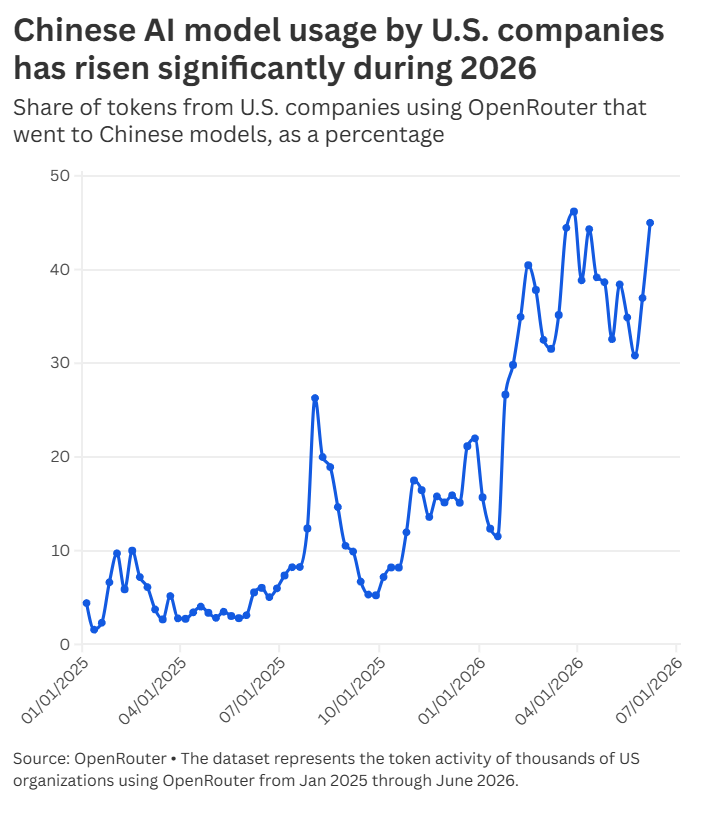
The first is price. Open-weight models from Chinese developers, led by DeepSeek and Alibaba's Qwen, now cost 60% to 90% less than the leading models from OpenAI and Anthropic while closing much of the performance gap . On OpenRouter, the largest neutral router of model traffic, Chinese models rose from under 1.2% of all tokens in late 2024 to roughly 61% by May 2026, while the American share fell from about 70% in mid-2025 to near 30% a year later .
Among US organizations specifically, the shift is just as steep. The share of their OpenRouter tokens routed to Chinese models climbed from low single digits in early 2025 to a peak near 46% by mid-2026 .
The switching is no longer confined to startups. Companies including Cursor, Airbnb, and Lindy have moved workloads onto Chinese open models to cut costs . These models can be downloaded, run without an internet connection, and kept, which removes the recurring payment the American labs are counting on .
The second is return. A widely cited MIT study found that 95% of enterprise generative-AI pilots produced no measurable effect on profit or loss, even as companies spent $30 billion to $40 billion on them . Much of the money that does not reach production is spent correcting what the systems get wrong.
Put the two together. If good-enough intelligence is becoming cheap and open, and if most corporate AI projects are not yet paying for themselves, the premium revenue that underwrites a trillion dollars of infrastructure looks less settled than the infrastructure itself .
The Economy Is Leaning on One Trade
The stakes reach past the companies involved.
Harvard economist Jason Furman calculated that investment in information-processing equipment and software, about 4% of US GDP, accounted for 92% of the country's GDP growth in the first half of 2025. Strip out those categories and growth was roughly 0.1% . The data-center build is the market's largest trade, and it is also propping up the country's headline growth.
That concentration is fragile because of how the build is now paid for. The companies driving it have historically carried little debt, and that is changing . The Bank for International Settlements found that AI investment needs "will require firms to shift the source of financing from operating cash flows to debt, with private credit playing a rapidly increasing role" . Direct lending to the sector has climbed from near zero to more than $200 billion .
Private credit does not carry that risk alone. Insurers and pension funds are among its largest investors, drawn by the long maturities that match their obligations . Private equity firms increasingly own the insurers that do the lending, the structure behind Apollo's financing of the Valor vehicle that owns xAI's chips . The chain runs from a compute lease in Memphis back toward ordinary retirement accounts.
Regulators have begun to name the channel. The BIS warned of "systemic spillovers, not least given the rapid growth of less transparent private credit markets and the circular financing within the AI ecosystem" . A group of US senators wrote that the debt loads could cause "destabilizing losses" for financial institutions and a broader crisis .
The buildout may still pay off. The AI being built could prove transformative over the next decade . But the financing behind it books revenue today that depends on the spending continuing tomorrow, and that money now runs through private credit into insurers and retirement accounts. None of it is against the law. A reversal would spread well past the technology sector, into an economy already leaning on this single trade .
Achraf Rachidi
Independent researcher. Aperta Res was born from a simple frustration: too much noise, not enough signal. The goal is transparent, data-grounded analysis that cuts through complexity.
AI is becoming dramatically cheaper and more efficient. Instead of reducing the industry's appetite for computing power, those gains are driving demand, investment and energy use to new heights.